Remember that English unit in middle school when all we read were creepy, traumatic short stories? Like the one where a man bricks someone into a wall and leaves him to die? Yes, those stories.
A lot of parents are concerned about the media their children consume. For movies, shows, and books, parents may consider a child’s maturity and age before they allow their child to see or read something. However, this does not seem to be considered in a middle school setting.
What happened to the happy stories that are fed to kids in elementary school? Or even the sad stories that teach life lessons? Why do all the short stories we read in middle school have a horrific element or turn that sends kids away in fear?
These are stories like “The Cask of Amontillado” by Edgar Allan Poe, mentioned at the beginning of this piece. Or “The Lottery” by Shirley Jackson, which ends with the entire town stoning an innocent woman. In “The Veldt” by Ray Bradbury, images come to life in a nursery. Images of lions, with help from the children, kill the parents. “The Scarlet Ibis” by James Hurst ends with a frustrated older brother drowning his younger brother. In another story called “A Rose for Emily” by William Faulkner, we learn that a woman has been sleeping next to a corpse for years.
These pieces are well written, and reading them as an adult, I have enjoyed them. We read literature for many different reasons. Sometimes for fun; sometimes to feel something—happy, sad, etc.; sometimes to learn something; and sometimes to think about something in a different way, to gain a different view on the world. That last reason is what these pieces seem to strive to do. I find the questions and issues these short stories pose quite thought-provoking.
In English class, the purpose of reading most—if not all—of the stories we read seems to be to show us a different view of the world and encourage us to think in a different way. However, when these stories are presented in a middle school class, I fear this is not achieved. I worry that all we hear are the horrific details before the bell rings and we move on to our next class, doomed to hear another terrifying story the next day.
Unfortunately, bad things do happen, and some things in life can be horrific. These stories often present exaggerated versions of things that could happen, which is what makes them so horrifying. But the kernel of truth in them, the part that could happen, is what makes them valuable. It’s what we can learn from. I’m sure that is what the teachers are trying to show us.
Maybe these themes and views are too mature for kids that age to process. Maybe they are too young to see anything but the horrific details; details that might not only scare them at the time but may turn them away from this type of literature forever. It’s possible that giving children these stories so early on, with so little discussion of the point of them, may prevent kids from trying to learn from something in stories and events like this later in life.
But maybe there is a way to teach these stories that allows kids to think past the horrific details and see the bigger pictures painted. To understand the deeper themes that exist there that allow us to learn and see the world differently. Or, maybe we can wait a little longer until a child’s maturity can help them learn from these stories and appreciate them.
By Rachel Waldvogel, Inscape Staff
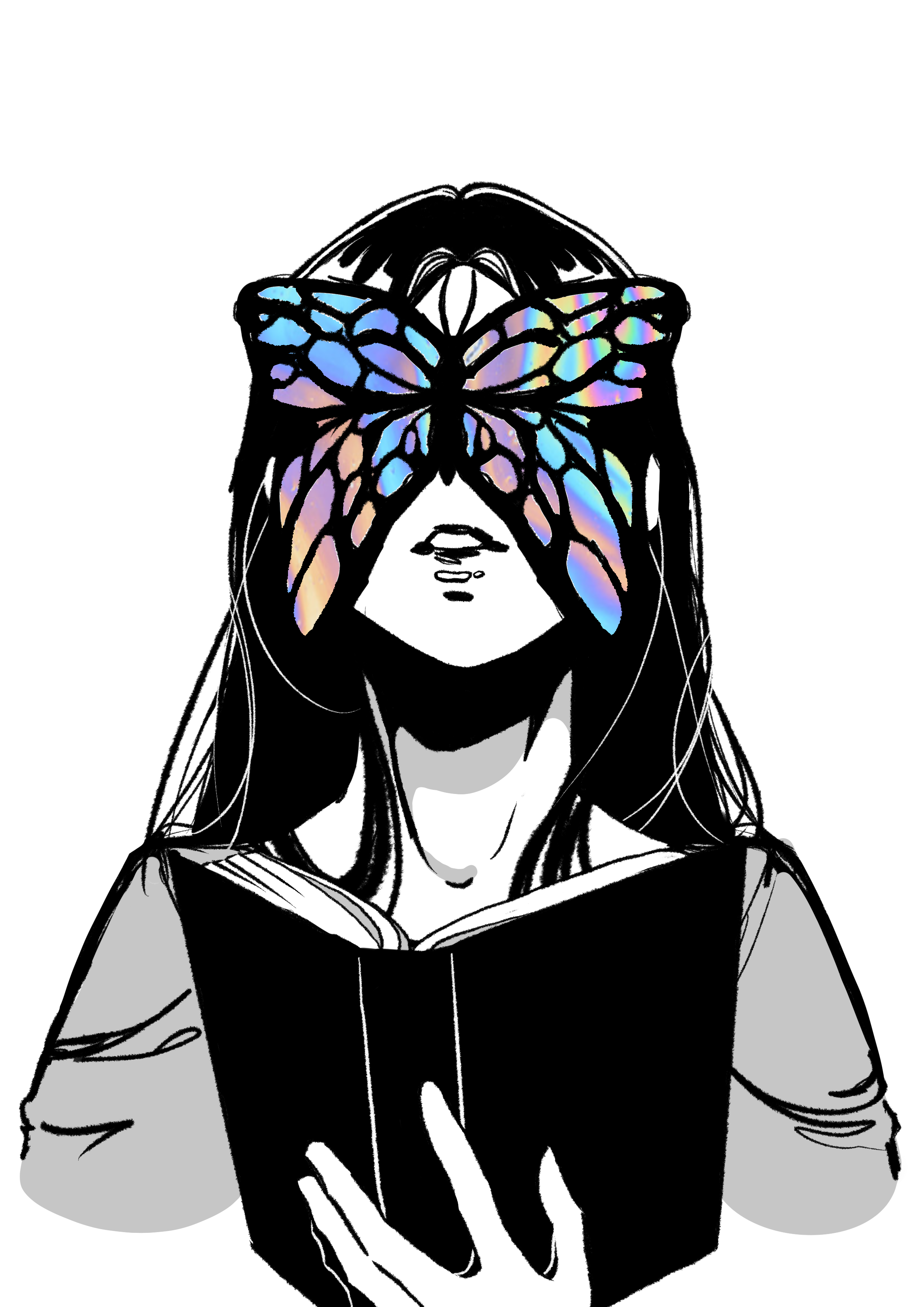
Header image by Isabella Mercer, Inscape “Metamorphosis” art contest honorable mention (2025)