About the Episode
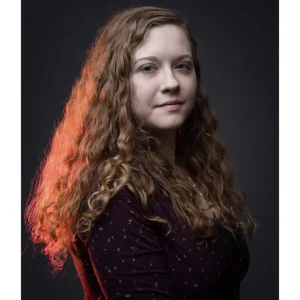
Lynn Buchanan is a fantasy writer based in the foothills of some impressive, chilly mountains in Utah. She is a 2019 graduate of the Odyssey Writing Workshop and holds an MFA in fiction from Brigham Young University, where she taught creative writing. When she isn’t writing about monster-fighting dolls, moody painters, and mummified arms used as dancing props, she enjoys playing the oboe, buying houseplants, and watching Ghibli films.
Music Credit: Alia Alexander
Header Image: Ice by MTS Pillay, Inscape Fall 2025
Transcription
00:00
Lynn Buchanan: Consistently writing is the best advice I was ever given. Commit to writing at a certain time on certain days and stick to that. You learn the most about writing by writing and practicing.
Host: Lynn Buchanan is a fantasy writer based in the foothills of some impressive, chilly mountains in Utah. She is a 2019 graduate of the Odyssey Writing Workshop and holds an MFA in fiction from Brigham Young University, where she taught creative writing. When she isn’t writing about monster-fighting dolls, moody painters, and mummified arms used as dancing props, she enjoys playing the oboe, buying houseplants, and watching Ghibli films.
Okay, Lynn, thank you so much for coming on our podcast today.
Lynn: Yeah, thanks for having me.
Host: Yeah, of course. I’m super excited to talk about The Dollmakers today. What a fun, interesting book that you have created. I feel like it feels so fresh to a lot of the fantasy I’ve read recently. And I’m so curious about the inception of this idea. Did it begin with the world? Did it begin with a premise? Did it begin with a character? Like, walk us through that.
01:22
Lynn: Yeah, so I actually got the initial idea for The Dollmakers when I saw a piece of art online. It’s by an artist named Zine Chin. I don’t think there’s, like, a specific name for the piece of art. I think Zine was just doodling—like, he was just doing a piece of art—but it’s of a woman making a really creepy-looking doll.
And I saw that piece of art, and I just immediately was like, “Yeah, I need to write a story about women who make creepy dolls that come to life.” That was, like, the very initial idea.
And out of that kind of grew this seed of an idea of, like, I wanted one dollmaker who made really beautiful dolls and one that made really kind of scary dolls. And that’s how I eventually came up with Shean and Ikiisa, the two kind of main dollmakers in the book.
But, yeah, that was the initial idea. Pretty simple. And I honestly get a lot of my ideas that way. When I come across a piece of art that really inspires me, whether it’s, like, an illustration or another book I’ve read or a TV show or a movie, that’s where a lot of my idea generation comes from.
Host: That’s so interesting. Would you say that you’re, like, a visual learner then?
Lynn: Um, definitely when it comes to writing. Things like visuals are what pull me the most into ideas. I don’t think I was that way in school, really, I would say. But with writing, it’s always been that way.
02:52
Host: That’s so interesting. I’m curious, then, when you do—do you, like, storyboard and rely on the visuals to kind of help you generate plot and characters and things like that?
Lynn: I don’t do any actual storyboarding, but I do think very cinematically when I’m writing. So it is like I have that visual first before anything else. So, like, when I’m going into a scene, I’ll be like—and I can see it in my head—Xian’s doing this, and then I come up with the words to, like, match that.
Host: Interesting. Do you feel like that is helpful, or does it sometimes limit you as a writer?
Lynn: Um, I find it helpful for the type of writing that I want to do and enjoy doing. I’ve never felt like it’s a hindrance necessarily.
I mean, okay, with the caveat of sometimes I will go overboard with my descriptions. It’s actually a tick I have to catch in my early drafts. I will, without noticing, put, like, four metaphors about the same thing in a row. So when I go back into my drafts, I have to be like, “Okay, choose one of the four metaphors. You can’t have four metaphors describing one thing.”
Host: I would say it’s always probably better to cut, though, than to have to make more, right? So, in reality, it’s maybe not that big of a problem.
Lynn: No, it’s not too bad. It’s just something I have to be aware of so I don’t accidentally leave any of those in final drafts.
Host: Yeah, that makes sense.
04:23
Host: I read through your acknowledgments of this book, which was so fun, and it kind of sounds like this book went through quite the process to get to be in the hands of readers. Do you mind sharing a bit of that story?
Lynn: I wrote the first draft of The Dollmakers in 2020, at the very beginning of the pandemic—like, that was my COVID project at the very beginning. I didn’t have a literary agent at the time, and it took me about six months to write it.
And then later that same year, I actually did sign with an agent for a different book that we then went out on submission with to editors. That book sadly died on sub, didn’t sell, and so I needed another book to show my agent. And I had The Dollmakers, so I gave that to him and went through a round of revisions.
And then that went out on sub, and about six months later, we sold it to a publisher. But that all happened in 202, and the publisher told us when they bought it that the book wouldn’t come out until 2024. So I had to wait for two years, which was honestly really hard.
Host: [Yeah.]
Lynn: So it’s kind of like—it was a really long process, though a lot of it was just waiting. You know, like, I wrote the book in six months. Like, total time working on the book, probably around eight months if we’re including revisions that I did on it.
Host: Pretty fast.
Lynn: Yeah, I do tend to write pretty fast drafts and pretty clean drafts. So the actual writing process doesn’t take too much time, but publishing takes a long time.
06:01
Lynn: And that was something I got to experience firsthand, for the book I wrote in 2020 not coming out until 2024.
Host: Yeah, that is actually a really long time. Because how do you—is that just practice and patience? Or do you feel like it kind of fueled you to do other projects, or…?
Lynn: I mean, while I was waiting, I was writing other things. The Dollmakers was my seventh book, and I’ve written 13, I think, now total, so I wasn’t not doing anything.
But it can be really hard sometimes with my brain, where I’m like, I’m working on a project I wrote years ago that’s suddenly getting published now, and I had to reverse, if that makes sense. A project that in my head is very done, but I have to pick it back up, and then it’s coming out to readers for the first time, and I’m like, “You guys are just reading it now? It’s been so many years.”
Host: That is really interesting because your readers would be reading it for the first time. The first time they’re engaging with the world at all is so fresh. I feel like that would be kind of interesting to be like, “Oh yeah, I forgot about that,” or “I’d never thought about it that way.” That would be kind of an interesting experience. Um, but hopefully a good experience, an exciting experience.
I am curious about having this being your first debut novel. What is that like to have people that you don’t know reading your book?
Lynn: I actually enjoy it for the most part. I mean, it’s stressful. I think any author would attest that there’s a lot of anxiety that goes into when you’re putting your books out and a wider audience is reading it for the first time.
But I’ve had a lot of really fantastic experiences since The Dollmaker came out, of fans reaching out, telling me how much they enjoyed the book, sending me emails about how much they were inspired by the story and things like that, and getting to meet some of them in person at book signings and things like that. It’s been overall a positive experience.
08:14
Host: I am curious about a new controversy, more or less, in the book world around a new category—a way for people to categorize books—called New Adult, which is basically, for our listeners, specifically marketed towards people who are 18 to 25.
And I feel like the controversy around this categorization varies depending on who you talk to. It’s either about marketing, content, or the ambiguous nature of a new category. However, one of the controversies that sticks the most is that a lot of people think it’s just YA with more explicit content.
And being that The Dollmakers doesn’t have explicit content, but has characters, I guess, that fall in this age range—or that maybe the readers would fall in this age range—what are your thoughts on a new category like New Adult? Do you find merit in it, or are you kind of against a new category? I’m curious.
Lynn: New Adult is really interesting to me. I’ve heard the phrase in the industry for almost a decade now. it’s kind of been floating around for a long time. I think it was about a decade ago when it first kind of popped up, and people in the industry tried to make it a thing at that time, and it kind of didn’t become a thing.
I think that is mostly because we have YA, we have adult. I agree that there is kind of an in-between space between those two, but it’s a lot easier for a publisher to grab an audience if they can choose one or the other.
So I think in traditional publishing, the reason New Adult hasn’t super taken off is because it’s too much of a gray area, and you’re not quite sure who you’re targeting when you’re doing marketing. Adult’s very clear how you target your audience; the same with YA.
So I don’t have particularly strong negative or positive feelings about the category itself. I think it hasn’t taken a root as well as people have tried to make it just because of that marketing situation.
10:53
Host: Yeah, I think that makes sense. Do you feel like there is maybe value in trying to make it a category? Because being in that age range relatively—I guess I’m kind of on the latter end there, almost aged out—I feel like there is merit to that because I feel like YA, sometimes I read it and I’m like, I just don’t really 100% relate to what’s going on here.
But then–then I’ve been–I call it–this isn’t a genre–but I call it, it a genre–It’s the books marketed towards middle-aged women, particularly in their 40s. And those are lovely books, but also books that I don’t necessarily relate to. I don’t have children, I haven’t gone through a divorce, or all of the various other things that make those books really engaging.
So there is, I agree with you, an in-between, certainly, and I wonder if there is maybe a potential to make that a bigger category or not. Or do you think, just for marketing reasons, it’s not worth trying to make a distinction?
Lynn: I’d probably lean towards marketing will always push back on that a little bit because they don’t want to lose the older readership for the adult space and they don’t want to lose the younger for the YA space. Though I do think in the adult space right now there’s a fairly big chunk of books, particularly in the fantasy genre, that fall into this category you’re describing, with relatively young main characters, early 20s to mid-20s. They exist, I guess, but maybe they’re harder to find because they don’t have their own category.
12:45
Lynn: But yeah it’s an interesting thing, though another trend I’ve been seeing–sorry now I’m just talking about trends in the industry–but another trend I’ve been seeing is a push, again and this is in the fantasy genre that’s what I primarily specialize in, but a push for actually older protagonists um because we have too many 20-year-old protagonists. I’ve seen it specifically around the 30-year-old range. I’ve been seeing a lot of chatter about that.
Host: Yeah, I would actually agree with that. It almost seems like people are really interested in reading characters that represent them a little bit more, and there’s only so many fantasy novels with characters in their young 20s that people want to read before they’re like, I couldn’t move my body like that, or I wouldn’t make that decision. So they’re maybe attracted to characters that are more relatable to them, which is, I think, one of the things about fantasy that a lot of people are driven to: characters that they really relate to.
Lynn: [Yeah.]
Host: Okay, well, fun. Thank you for discussing that with me. I’ve been so curious about people’s opinions on that.
I want to talk a little bit about your decision to not include chapters in your novel, because The Dollmakers is one of few fantasy novels I’ve read that doesn’t have chapters. In fact, off the top of my head I don’t even know if I could name one specifically. I’ve read quite a few literary pieces that don’t have chapters, or regular adult fiction that don’t have chapters, but as far as fantasy goes I feel like that doesn’t happen very often. So I’m curious as to why you made that decision.
14:26
Lynn: Yeah. So when I write a book, I do not include chapter breaks. I found that when I do that, it really disrupts the flow of the story for me. And it will mess up the pacing. It’s a completely mental tick of mine. There’s no reason it should be this way. It just is.
So when I’m drafting my books, they’re just naturally not broken into chapters, and when I sent The Dollmakers to my editor, that’s the form it was in. He really liked that there weren’t any chapters. He thought it was a really unique kind of tick to the book, so he proposed that we just didn’t add chapter breaks.
I had always planned on going back and adding chapter breaks to the book, but he felt like we should leave it, so we did. Not really a deep response, sorry—not like a deep reason outside of I just write that way and my editor wanted to lean into it, so we did.
Host: I think it works because it makes the I feel like it did help the story flow because chapter breaks are a natural pause button almost. And if there’s no pause button, naturally, you just are like, well, I guess I’ll keep reading. But that’s cool that’s the way that you write. That’s so interesting. I’m glad that it’s helpful for you.
I’m curious. Do you anticipate having chapter breaks in further projects, or do you think that will just kind of become your thing?
Lynn: I think I will have chapter breaks in my next book. Well, okay, I know I will, because it is twice as long as The Dollmakers. And kind of what you were talking about you know that kind of without chapter breaks, you feel like you just need to keep reading. That works okay with a book that’s about the length of The Dollmakers; it’s not too long. My next book currently is like 800 pages. I think people would die if they were trying to read that all in one sitting. So yeah, I’m definitely gonna break it into chapters.
16:20
Host: That makes sense. I actually have a funny comment about that. The other day on Instagram, I saw there’s a trend right now. I’ve seen two book creators do this trend where they’ve read the entirety of It by Stephen King in one sitting, which is like a 1,200-page novel.
Lynn: [Oh, wow.]
Host: Yeah. And one of them, it took them 13 hours and the other, it took her 10 hours. Both of those are just shocking to me. I couldn’t imagine trying to read an 800-plus-page novel in one sitting. I find that quite funny.
Lynn: Yeah, that would be hard.
Host: One of the girls said her eyes by the end were really hurt, and I’m like, yeah…
Lynn: I could see that.
Host: So I appreciate you not expecting your readers to do that because that would be quite the adventure.
Lynn: Yeah
Host: But…So, I want to talk about Brandon Sanderson, who you mentioned as one of your mentors in your acknowledgements, described the book as an engaging new voice with excellent world-building. I feel like that’s pretty high praise coming from the king of world-building himself. What does it take to have excellent world-building, and what was it like to build the world of The Dollmakers?
Lynn: I think with world-building, three things to consider is: you need to be logical, consistent, and detailed. For me personally, as long as your reader can buy what’s happening in your world-building, they’re gonna love it. But if you break that kind of immersion in any way, they’re gonna be raising eyebrows at you and not believing it.
So, those are kind of like three things I think about when I’m building out a world. For example, with The Dollmakers, a lot of the world-building came from aesthetics that inspired me with the book, as well as me logically thinking through what a country dependent on living monster-fighting dolls would be like, right? How would people in that world would act? How’d they interact with each other? How’d they interact with this really dangerous world they live in. That is being handled by relatively small, weak-looking creatures with the dolls. That’s how I built the world-building in The Dollmakers. It really tied to the magic system and how those two things played with each other.
18:53
Lynn: Uhm, in terms of like getting good at world building.
My really only advice is to write a lot and practice a lot, which is bad. It’s not bad advice, but it’s frustrating advice. Right. When you hear like just write a lot, you know, then you’ll get better at it. But sad. It’s sad. But true.
Host: Yeah. Unfortunately, it’s, there’s only one path forward, right? And if you do, if you’re, if you’re not excited by the prospect of becoming a better writer through writing, I think maybe you should pick a different vocation, right?
Lynn: Though in all fairness, there’s often times where I enjoy having written more than writing, if that makes sense.
Host: A 100%. There are days where you have to motivate yourself to do the thing that you love to do.
There is absolutely truth to that. Uhm, okay, so I was very excited to see that The Dollmakers has really excellent reviews on Goodreads. I didn’t check Amazon, but I’m pretty sure it’s going to be the same relatively there as well.
20:12
Host: Like you have several thousand reviews and a lot of ratings and several hundred reviews and all have great things to say. I’m curious, how does that success feel for a debut novel? Is it mostly motivating and inspiring or is there some anxiety that comes along with that as well?
Lynn: Um, I mean I love seeing that the story resonates with people. Uh, that’s very gratifying. It’s great to see that it’s found an audience that enjoys it. Um, it is also, I mean reviews in general make me anxious. Um, I try, I try my best not to look at them too much just for the sake of my own sanity. But I do, yeah, I am, I am very grateful that it’s found so many people that enjoy it and it’s, it’s, it is, um, I’m sorry I already used the word gratifying, but it is, um, it was, it’s very gratifying after spending so much time on a project to see people picking it up and enjoying it.
Host: Absolutely. It’s like the cherry on top of the sundae, right? Like it’s just, it’s a nice, it just feels good.
Now what I found really interesting is that the, the only thing that I think would have made your reviews higher, not, um, not in a bad way necessarily, is a lot of people had a lot to say about your main character. And you pronounce it Shean?
Lynn: Shean
Host: Shean. She, um, I, and I read this one review by this, um, guy named Patrick, I’m assuming, and I feel like he summed up the, um, opinions well. He said, “The Dollmakers is a coming-of-age story with themes of ambition, revenge, letting go, dreams, and artistry done right. However, to experience the fulfillment—
21:51
Host: of the narrative, Buchanan requires her readers to be patient with one of the main characters, Shean. To put it simply, for more than half of the book, Shean is an extremely arrogant, hot-headed, selfish, childish, infuriating, and unbearable character. Do not expect to fall in love with Shean quickly.”
However, later on, he praises your ability to write a character with stark contradictions and one with a huge character arc payoff. Shean becomes a completely different person by the end and is very believably written. I’m curious if you knew that Shean was going to be difficult for readers to like in the beginning and if you faced any challenges while writing her.
Lynn: Yes, I 100% expected people not to like her. That was, that was very intentional on my part. Going into The Dollmakers, one of the, the things I wanted to accomplish with the story was writing a very stark and dramatic character arc. And have a really stark drag character arc, you often have to start with a character that’s at a pretty low point at the beginning. Um, which she is. She is awful. Uh, awful, awful. Um, so bad.
Um, I’ve heard, I, I think one reader told me they wanted to push her off a cliff for like half of the book and I’m like, yeah, yeah, that’s a valid, [yeah, yeah], I’m like, yep, that, that, yep, you should. That’s completely what I was going for.
Um, and you know there’s like trade-off there. I know some readers will definitely not enjoy the book because Shean is not meant to be a relatable character or she’s not, um, actually I’ll revise that. She’s not—
23:32
Lynn: meant to be a likable character. I’d push back on her not being relatable because I think we’ve all, okay, no, not all of us, but I definitely, there, there are some of us that have gone through phases in our life where we’ve acted like her, maybe not to, to the extreme that she does in the book, but everyone has an ego to some degree. Everyone has ambitions that they want to fulfill and think that they’re right when they’re wrong. So I won’t say she’s not relatable, just not likable.
But the other part of your question, right? Your other part of the question was if it was hard to write her. It wasn’t actually. Um, I actually quite enjoyed writing Shean, I think in part because of the things I was just talking about. Um, ambition exists, ego exists, wanting something so badly that you become blinded to what’s going on around you is a real thing that happens.
Um, now does that mean I’m condoning punching people and lying and stealing? No, definitely not. Um, I did take Shean to a pretty extreme place. Um, in part because I wanted to do her character arc the way I did. But, um, I, I think it’s important that we have fiction that shows people at their worst and then learning from that and becoming better. Um, and that’s what I wanted with Shean.
Host: Well, it was certainly a satisfying character art to see her go from, I don’t know, our first interaction with her versus our final interaction with her. I, the character growth that she experienced is very obvious.
25:09
Host: And it makes you… I feel like my experience as a reader was by the time I got to the end of the book, I was like, oh, okay, yeah, I’m invested in this person because I saw that she grew, and that is a really satisfying thing for a reader I think. And I do agree with you, I think she is unfortunately a relatable character. I just think a lot of people wouldn’t want to feel like they relate to her.
Lynn: Yes.
Host: That would mean that they are maybe not as great as a person as they thought they were, right?
Lynn: But again, I think that’s part of why I wanted to write Shean the way I did. Um, is showing her learning and growing and like when she realizes, like when she really realizes how awful she’s been, she corrects, or she tries to. And I think that’s realistic as well. I, I think people are inherently evil. I think they can get blinded again by those things I was talking about, ambition and desire and things like that. And, and the, when you realize you’ve done something wrong, the best thing you can do is course correct immediately, like do your best to course correct.
Um, and yeah, sorry, this is a bit of a tangent for me, like a silk box.
Host: No, I think it’s true though because I think one of the cool things about reading fiction is it’s, it’s models for real life truly. So like when we read characters with immense personal growth it inspires us to be better people and it also kind of shows us what, what people we do want to be, what people we don’t want to be. There’s immense value in reading fiction.
26:46
Host: And I think one thing that is cool about Shean is that she does, almost as soon as she realizes, I have not been a really good person, she is immediately different, which is honorable. And she still maybe is a little forceful. She’s trying to now be forcefully good, which I think is kind of sweet.
Lynn: Yeah, she’s still Shean. She’s still herself, but she’s trying, at least.
Host: Okay, now speaking of Shean just in general, I was so fascinated that our introduction to her as a character is not through her own perspective. Introduction to her as a character is not through her own perspective. We first get the perspective of Licensor Matock, or Matock?
Lynn: Yeah, yeah.
Host: And then her Master Nock, and which is actually quite a few pages before we actually get into Shean’s like head herself. And I’m curious why you chose to do that. What effect do you imagine that has on the reader and the reader’s expectations for Shean as a character?
Lynn: Yeah, what you’re talking about was very intentional.
27:53
Lynn: Well, we’ve talked about it, kind of like what we’ve been talking about. Shean is a very hard pill to swallow, right? And she has her redeeming qualities. She has her redeeming qualities, but I wanted to show her from an outside perspective so we could see those redeeming qualities before we went into her head with her very skewed perspective of I’m the best thing on this planet and everyone should bow to me, right?
So, um, I, with showing first Matock point of view where she is kind of more, um, the way that the reader is reacting to she on, wow, what a brat, right? And then going to Nock who loves she on and can look at her and be like, no, she’s, she’s, there are good things here, you know, like she, she does have potential and part of this is maybe my fault for spoiling her, you know, things like that.
Um, I wanted to give those two perspectives first so that readers had those ideas in their heads so that when they got to Shean they could recognize that she was unreliable, that, uh, her perspective of the world was skewed, but remembering that from an outside perspective there are things about her that hint that she can be better.
Host: And I think that was very effective. It worked for me because it was interesting being like, okay, these, these are what other people think about Shean and then I was like, I was ready to be like, okay, now I want to like be with Shean herself so that I can make my own decision. And so it made her intriguing to me because I was like, okay, this is going to be the main character and who is she still?
29:31
Host: It was kind of exciting. So well done for doing that.
Lynn: Thank you.
Host: Um, what I, what I, one thing about Shean that I really loved was kind of the connection slash, um, I guess intriguing relationship that develops between her and Ikiisa. They’re a reflection of each other but yet also opposites, and that kind of relationship I guess changes throughout the book because, you know, Shean is bold, cocky, volatile, while Ikiisa is super humble and repentant and kind of a recluse. And Shean takes, like, no responsibility for most of the novel, and Ikiisa takes all of it onto herself. She blames herself for everything.
So I thought it was interesting that towards the end of the book, Ikiisa makes, and I’m going to quote your writing here, she makes this realization while she’s looking at Shean. She says, “That was her, wasn’t it? That hunched figure sitting across from her in a rumpled dress with hair and tangles, her leg in bandages, tears dripping between the gaps in her fingers.”
30:40
Host: “Wasn’t that another Ikiisa softly weeping right there? A reflection, a mirror.” Beautiful. I, can you tell us more about how these two characters are or personalities are in conversation with each other?
Lynn: Yeah, so I definitely wanted Ikiisa and Shean to be foils for one another. Um, this kind of goes back to the very first question we talked about with the inspiration for the book, where I had that seed for an idea of like one dollmaker who makes really beautiful dolls, one that makes scary dolls. And as I was fleshing out that very basic idea, because I like irony. I was like, okay, well the woman who makes beautiful dolls is awful and the woman who makes ugly dolls is like the sweetest person on the planet, you know? That was kind of like a launching point for their two characters.
Uhm, and as, and that, it developed as I got into the writing of the book and I wanted kind of what you were talking about. I wanted to show these almost two polar opposite people that in a lot of, like they almost have opposite problems from each other, right? Shean is too arrogant, Ikiisa is too self-deprecating, and by interacting with one another they bring out those, they kind of like pull each other closer to an equilibrium, right?
32:05
Lynn: Like through her interactions with Ikiisa, Shean realizes she needs to not be so arrogant and think about other people and take responsibility for the mistakes she’s made. And Ikiisa interacting with Shean realizes that she should stop taking abuse from people for things that are not her fault. And be a little more like Shean, be a little more bold.
And so that relationship between them just felt, it’s really the heart of the story, their relationship, I think, and what they teach each other and what they learn from each other. And it just, it clicked pretty naturally when I got into the actual writing of the book.
Host: Yeah, I mean I thought it was very engaging. I was very excited for Ikiisa to learn a bit from Shean and Shean certainly to learn a bit from Ikiisa and I thought it was, um, I thought it that happened beautifully and in a really natural way with these women being inspired by one another and also, but also envious of the other. I thought that was really interesting.
33:12
Host: Now technically The Dollmakers is marketed as a standalone fantasy, but, and it does follow a complete arc, but having read it I’m pretty confident as a reader that this is not the last we are going to hear about this world and Shean is a character and I’m hoping Ikiisa too. Can you, can you tell us a little bit about it?
Lynn: Yeah, so I do have another book coming out in this series next year, spring 2027.
Host: Okay.
Lynn: Um, the title of the book is Breeze Felt at Moonrise and it’s set in the same world as The Dollmakers but in a different country, a place called the 10 regions, where people, um, can grow crystal armor out of their bodies. Um, there’s actually a scene in The Dollmakers where she on meets someone who’s made out of crystals. Um, it’s that country. Um, and that, that people.
So sadly Shean is not in this book.
Host: Um, sorry.
Lynn: Yeah, it is in a different country. Um, it does have a crossover character 34:25 [….? traveling linguist and translator.]
Host: Yes.
Lynn: Uh, so he is in Breeze Felt at Moonrise. Um, and there are dolls in Breeze Felt at Moonrise. It’s not the focus, but there are dolls. Uh, so, um, but yeah, it, um, i, I always had a vision for this series of writing quote-unquote standalone books set in different countries in the world and fleshing out the overall magic system for the world through different standalone stories with different characters.
34:57
Lynn: And then the character that’s in all the books is Roque. Shocker, if you’ve read the book, I’m sure.
And I actually have written another story with Ikiisa. It’s a little prequel novella called Master [Cohen’s?] Apprentice that you can get for free if you sign up for my mailing list. Yeah, and it’s about how Ikiissa grew up and her backstory with her master who adopted her and how she ended up in Web.
And that was really fun, fun. It was really fun to revisit that, but, um, at the moment I don’t have, I mean okay I can’t say that I do have other ideas for things with Shean, but there are other stories that I’m focusing on for the moment.
Host: Okay, cool. Can you tell us, um, and can you give us any hints as to these other projects?
Lynn: Yeah, well, so I have Breeze Felt at Moonrise coming out next year. But it follows the story of a young woman who’s trying to prove herself to her people by destroying the crystal that she’s growing out of her body. Which leads her on a journey across her country with Roque.
36:05
Lynn: A journey across her country with, um, with roque and she gets really tangled up in the politics and wars of the country and has to face kind of this nuance of having power thrust upon her that she never wanted or asked for. Um, so that’s what, that’s the general premise of Breeze. I’m sorry, the title is long so I tend to shorten it.
Um, and then I also have another book that’s on contract that will be coming out in 2028. Um, can’t say quite, it’s also set in the same world as The Dollmakers in a different country, uhm with Roque. I can’t say quite as much about this one, but it’s, um, it involves a seafaring people and a bone monster and cat griffins. Those are very important.
Host: Oh my gosh, that sounds exciting.
Lynn: Yeah, so I have those two on contract right now. I mean I’ve, um, how many have I written? Uh, I think I’ve written seven books in this series already.
Host: Um, that is a lot.
Lynn: So yeah, well kind of going back to what we talked about earlier about how long publishing takes, I often feel like I’m, I don’t, I said not that I feel, I just straight up and much faster than the, than publishing, um, than the speed that traditional publishing moves. So many books, many books in this world coming.
Host: Okay, that is so interesting. Yeah, because you’re basically eons ahead of your readers at this point.
37:36
Host: But I would find that difficult to not, I guess, not give things away so much as be like, oh, wait, you don’t know that yet? Like, I swear. But yeah, you’re doing great. You haven’t revealed anything. But that is really interesting.
Um, do you find that because you are so fast you’re, um, I guess do you put out multiple books on submission all at once and just kind of see what happens? Or are you just like every year you’re coming out with a new book and you’re just then that process begins and then four years or whatever later that’s when that book is going to come out, so you’re just constantly four or five years ahead of the schedule?
Lynn: Um, it’s more the latter of just kind of being ahead of everything. Uh, it’s not, I mean when you’re going on submission to editors the only time I think my edit, my agent would let me put multiple books out on submission would be if they were in completely different genres or age ranges. So if I had a YA book and an adult book he’d probably be okay putting them both out at the same time to editors. But if you’re sending a manuscript out in a certain age category or genre you probably can’t do more than one at a time, typically speaking. Which, believe me, frustrates me because—
Host: Yes, I can imagine that’d be frustrating, but it also kind of makes sense because I feel like they want all the focus to be—
Lynn: Yeah, yeah, it does. Um, you know, and it’s tricky sometimes to distinguish the lines of like, is this book enough of a different genre from this one, if that makes sense? You know, like the lines can blur—
39:15
Lynn: sometimes with that. Um, and ideally when you sign with an editor you’re going to be staying with them for many, many books in the future, right? And so that also adds to like the speed of which you go out on submission and things like that.
Host: Okay, that, that is, that is nice. I’m curious then, have you written, um, because obviously The Dollmakers, um, despite our, our discussion earlier about the new adult, it is an adult fantasy. It’s marketed mostly as an adult fantasy.
Lynn: Yeah.
Host: And I’m curious if you’ve written in the YA, um, field, if that interests you or if you’re, you are just happy in the adult fantasy world.
Lynn: Um, I’m pretty happy in the adult space. Um, I used, like when I was a younger writer I wrote more YA. Um, I don’t know if it was just kind of a natural thing. I wrote my first book when I was 14. And I think I was reading YA at the time as a 14 year old, right? And so I think just naturally, I was like, Oh, well, that’s the, that’s what you write in, you know, like you write.
So I started out writing YA, but as I got older and read more and read more widely, I found that I tended to not like kind of go towards adult more and enjoy writing adult more. So I’ve landed there pretty firmly. I don’t think it’s out of the range of possibility that I’ll write a YA book in the future, but for now I mostly stick with adult.
Host: Yeah, fair enough. I feel like for me writing and reading in the YA field feels like eating candy to me. Like it’s just so, so fun—
40:55
Host: –not that it’s not unserious or not that it’s unserious necessarily, just so it can be, it can be fun jumping into your younger brain and experiencing the world through those eyes.
Lynn: Yeah. And, and I’ll also say, a lot of times, like, when I’m writing, I’m not thinking, like, this is adult, you know, like, that isn’t, like, what I’m thinking. Quite often, and I know I’ve heard other writers talk about this, um, your writing will often, like whether you’re writing YA or adult, will often be decided by like your agent and your editor when they, like when they read it and they get a vibe check on it, if that makes sense.
So, so my stuff just, the vibe check has been adult, um, generally speaking from the people I work with. It’s, yeah, you write adult, and I’m like, cool. Um, but it’s so nebulous and so at sometimes I feel like it’s almost arbitrary.
Host: I just had a friend who she wrote an entire middle grade novel. Um, it had some mature themes, so I think when her agent, um, read it he was like, yeah, this is YA. And she was like, he’s like, he’s like nine. And he’s like, not anymore. And so she just had to basically rewrite the whole thing with him as a teenager.
And I think it’ll end up being for the best. I don’t know if she’s finished with that, but it definitely is kind of like you said arbitrary. It depends really just on you, and this is why you have to trust your agent, right, that they know what is best for the—
42:31
Host: market and, but also for your story, right?
Lynn: And I mean I have a book where the main character is, it’s changed a few times, but I think he’s 14. I think that’s finally where I landed. Um, it, and it’s an adult book, very much an adult book. Um, so that’s another thing. You can totally have adult books that have teenage main characters. Um, I think it’s a little less common to have teenage book, like YA books that have adult characters as the main focus. Um, but there’s definitely adult books that have even younger. I mean I think how old is the main character in The Book Thief?
Host: Eight.
Lynn: Yes, you know. Um, and that’s, and I’m pretty sure it’s marked, oh, it’s marketed as YA in the U.S., isn’t it?
Host: It’s marketed as YA in the U.S., but it’s actually marketed as adult everywhere else.
Lynn: So, you know, it’s just so, that I think that’s a good example right there, right? He wrote a book with an eight-year-old as the main character. In every other country but the U.S. it’s marketed as adult. In the U.S. it’s marketed as YA.
Host: And I wouldn’t be, and I think I actually heard him talk about this, the author. He, he said the reason it was marketed as YA is he owed his YA editor a book and this is what he had, so he gave it to—
Lynn: So, you know, it’s just like, okay, you know, like it’s funny when you hear those stories.
Host: Um, it’s like what are even these categories at this point? Like because we’re so, we’re jumping all over the place.
Lynn: Uh, yep.
Host: That is pretty funny. But the categories are important. They do help.
Lynn: They are.
Host: They do help authors and they do help, um, they do help publishers and I feel like it can be helpful—
44:14
Host: especially as a new writer to be like, okay, I’m going to write in this genre in this age range, because when you just, I feel like sometimes when the, when all of the opportunities are available to you, I feel like you can get a little lost. So maybe for some people if it’s helpful for you to narrow down—
Lynn: Narrow down.
Host: Yeah, yeah. And also don’t worry about it too much. Um, write the story the way it needs to be written.
Lynn: 100%.
Host: Okay, well wrapping up here, thank you so much Lynn for talking with me. I appreciate it. I’m curious, what is the best piece of writing advice you’ve ever received?
Lynn: Write, profound, huh? No, sorry, I’ll stop. I’ll stop being sarcastic. But no, in all seriousness, consistently writing is the best advice I was ever given. Commit to writing at a certain time on certain days and stick to that. You learn the most about writing by writing and practicing.
Kind of like connected to that, another piece of advice I would give is learn how to take and apply feedback.
45:27
Lynn: So be in writing groups, or if you don’t like writing groups, find critique partners.
Host: Yeah.
Lynn: Just find people who give you honest feedback and then learn how to tell when that feedback is actually helpful or not.
Host: Interesting. What is your schedule? Do you have one for writing? I’m curious.
Lynn: Yeah, so I, well, it depends on the project I’m working on. Um, at the moment my schedule is I get up around 5:30 or 6 and I write until about 10 or 11. Um, every weekday and then, and then I go to work for the rest of the day.
Host: Sometimes it can be a lot.
Lynn: Yeah, but it’s, that’s the schedule, like getting up and writing. So my, my, my minimum when I’m drafting a book is I need to write at least 2,000 words every weekday. And when I’m revising a book I need to spend at least like four hours on revisions every day. So that’s kind of like my baseline.
I’m a relatively fast writer, so I can usually get 2,000 words out in two hours, which means sometimes my writing time is shorter depending on the day. Um, but it’s really, like all of that aside, all those technicalities I guess aside, the main thing is just I am consistent and that has helped me a lot. Um, with maintaining this schedule has made it so I can write, I think I’ve written 12 or 13 books in the past like six years, right? Six or seven years.
47:09
Host: And I, a lot of that has to do with just being really consistent and having this schedule.
Lynn: Yeah.
Host: I mean, if it works for you, it works for you. Whatever, whatever helps, makes it so that you’re actually doing the writing.
Lynn: Yes.
Host: Do that.
Lynn: Yeah. And like when I say consistency, I say consistency, I know I’m giving my example, but consistency can be I like you write on Mondays for two hours, you know, or consistency can be every Saturday I spend a couple hours, you know. It doesn’t have to be what I do. It really is just that like pick it, make a schedule and stick to that schedule as much as you can.
Host: Yeah, and that’s how you form habits, right? As you—
Lynn: Yeah.
Host: –do them consistently. So I think that’s really great advice. Um, okay, last question here, Lynn. This is, uh, one of the questions that we ask all of our guests. Um, you know, here at the Author’s Inscape we, one of our mantras is that we find art that is bizarre, believing, and beautiful. And I love asking the question, what is something bizarre, believing, and or beautiful that you have read or seen recently?
Lynn: That’s a great question.
48:17
Lynn: I have a few.
Host: Please, share.
Lynn: Yeah, well I really love a show called Scavenger’s Reign, which is an animated science fiction series on Netflix about a crew of a spaceship crash that’s like crash landed on a really strange beautiful planet as they all struggle to like survive. It’s like beautiful horror. It’s the only way I could describe it, and it’s just, it’s great.
Um, I also really loved the movie adaptation of Project Hail Mary. I think everyone is enjoying that a lot right now. Um, and then there’s another movie on Netflix called Lost in Starlight that’s about, um, an astronaut going to mars while she’s trying to navigate her relationship with her boyfriend. That’s super, uh, what’s it called, underrated. Severely underrated. It’s super super good. So, Lost in Starlight.
Um, and then to talk about books instead of movies, um, I recently finished Lois McMaster Bujold’s most recent novella in the Penric and Desdemona series. Um, I highly highly recommend the Penric and Desdemona series. Um, it’s about a young man named Penric who due to a really pure-hearted act of kindness ends up sharing his body with a demon, uh, that’s made up of the personalities of 12 dead women and a lioness and a horse.
Um, so Penric as a main character is just kind and good and always trying to do the best for those around him while trying to navigate this really like dramatic and dangerous thing that happened to him because of his kindness, you know. Um, so it’s just fantastic. I love that series. Not enough people read them—
49:54
Lynn: –so I love plugging them.
Host: Yeah, I haven’t heard of that. That’s so interesting.
Lynn: Yeah.
Host: Well thank you for the amazing recommendation. A lot of science fiction in there. Do you write at all in science fiction or are you just a reader or a lover of science fiction?
Lynn: More a lover of science fiction. When I first started writing, I 100% thought I would be a science fiction writer. And then, so my first projects were all science fiction and then I, and then I tried fantasy out for the first time and realized I was wrong and fantasy was what I was going to be writing.
Um, I, I still have a few science fiction projects I plan on writing in the future.
Host: Well, because why not?
Lynn: Yeah, because I like science fiction. Um, so I’ll probably, I’ll get around to those eventually. But yeah, primarily fantasy, but I do like science fiction.
Host: Okay. I love that. It just goes to show you, we’re not all one trick ponies over here.
Lynn: Yep.
Host: Well, thank you so much, Lynn, for coming on the author’s inscape and talking with me about your wonderful book, The Dollmakers, and all of your upcoming projects that our listeners can anticipate.
51:00
Host: Participate.
Lynn: Yeah. Thanks again for having me. It’s a fun time. Yeah, thanks again for having me. It’s a fun time.
Host: Hello, I’m Starlee Pratt, and I want to thank you for listening to this episode of The Author’s Inscape, a podcast hosted by Inscape, a literary journal. We’d like to give a special thanks to the English department at Brigham Young University, our host institution, and to Aaliyah Alexander for writing and producing the music in this episode.
If you are interested in more episodes or want to learn more about our journal, please head to our website, inscape.byu.edu. Thanks again for listening. Thank you.